


CNC Machining for Aerospace Components
2026-09-14
Aerospace manufacturing is one of the most precision-driven, safety-critical industries in the world. Aircraft, unmanned drones, satellite systems, and aviation electronic equipment operate under extremely harsh conditions, including dramatic temperature differences, strong air pressure changes, continuous mechanical vibration, and long-term fatigue loads. Therefore, every aerospace component requires strict precision, lightweight performance, high structural rigidity, and reliable stability. CNC precision machining has become the most trusted manufacturing method for modern aerospace custom parts.
Table Of Contents
|
1. Why Aerospace Relies on CNC Machining |
|
2. Common Aerospace CNC Components |
|
3. Main Materials for Aerospace Machining |
|
4. Professional Surface Treatment & Process Support |
|
5. Aerospace Industry Standards |
|
6. Our CNC Manufacturing Advantages |
|
7. Conclusion |
Why Aerospace Relies on CNC Machining
Aerospace parts allow almost no dimensional deviation or structural defects. Even minor errors can affect flight safety and equipment stability. CNC machining outperforms traditional manufacturing in precision, consistency, and complexity control.
• Ultra-tight tolerance control: Advanced 3-axis and 5-axis CNC machining centers maintain stable precision within ±0.01mm and achieve ultra-smooth surface finishes. This effectively reduces friction, avoids stress concentration, and prevents part fatigue failure during long-term aviation operation.
• Complex structure processing capability: Aerospace designs widely adopt thin-wall structures, irregular curved surfaces, deep cavities, multi-angle holes, and integrated frames. 5-axis CNC one-clamping processing ensures high accuracy and structural integrity for complex shapes that ordinary machines cannot achieve.
• Excellent repeatability and traceability: Digital programming ensures identical quality for prototype samples and batch production. All machining parameters, inspection records, and material reports can be fully tracked, meeting strict aerospace industry quality requirements.
Common Aerospace CNC Components
We specialize in custom CNC manufacturing for aerospace, drone, and aviation industrial applications:
• Lightweight aluminum alloy structural frames, support brackets, and mounting bases
• Inertial navigation sensor housings, shielding covers, and precision positioning fixtures
• UAV fuselage parts, camera gimbal structures, and surveillance equipment mounts
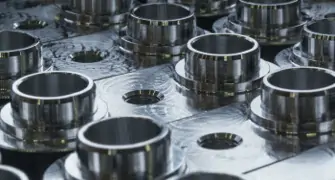
• Aviation connectors, high-precision fasteners, and bushing components
• Heat-resistant engine accessories, pressure-resistant structural parts, and customized mechanical parts for aerospace systems
Main Materials for Aerospace Machining
Material performance directly determines the safety and service life of aviation equipment. We select aerospace-grade materials strictly according to customer drawings and industry standards:
• Aluminum 6061 / 7075: Low density, high strength, excellent machinability and corrosion resistance, widely used for lightweight aerospace structural components.
• Titanium alloy: High temperature resistance, high tensile strength, and anti-fatigue performance, suitable for engine parts and high-load aviation components.
• Stainless steel: High hardness, wear resistance, and stable performance in high-altitude and humid environments.
• High-performance special materials: Superalloys, PEEK, and Ultem for insulation, high-temperature resistance, and special aviation scenarios.
Professional Surface Treatment & Process Support
Aerospace parts require strict surface quality and environmental resistance. We provide complete supporting processes:
• Anodizing, hard anodizing
• Sandblasting, polishing
• Passivation and anti-corrosion treatment
• Precision deburring and high-precision flatness calibration
All surface treatments follow aerospace-grade standards to ensure oxidation resistance, insulation performance, and long service life.
Aerospace Industry Standards
Our aerospace machining strictly complies with international aviation manufacturing specifications:
• AS9100 aviation quality management standard
• FAI First Article Inspection for prototype verification
• Full dimensional inspection report, material certification, and process traceability files
• Strict tolerance inspection and visual quality control before delivery
Our CNC Manufacturing Advantages
We focus on high-precision custom CNC machining for aerospace, drone, and high-end precision industries, supporting R&D prototype samples, small-batch trial production, and formal mass orders.
Equipped with professional 5-axis CNC equipment and mature precision processing experience, we solve common industry difficulties such as thin-wall deformation, complex position tolerance errors, and poor surface finish. We provide stable quality, fast lead time, and complete inspection documents to support customers’ aviation project certification and product iteration.
Conclusion
With the rapid development of commercial aviation, industrial drones, and aerospace technology, the demand for high-precision, lightweight, and high-reliability aerospace components continues to grow. Professional CNC machining ensures dimensional accuracy, structural stability, and consistent batch quality for aviation parts.
We provide one-stop custom CNC machining solutions for global aerospace clients.
If you have any CAD drawings or customized precision part requirements, welcome to contact us for professional technical analysis and competitive quotation.
- CNC Machining for Automotive Components: Precision Driving the Future of Mobility
- Difference Between 3-Axis and 5-Axis CNC Machining

Get an online quote and injection molding design analysis today.