
CNC Machining for EV New Energy Components: Challenges & Solutions The rapid growth of electric vehicles (EVs) and new energy transportation has raised extremely high standards for precision manufactu…
(Content in this language is being translated. Showing English version.)
The rapid growth of electric vehicles (EVs) and new energy transportation has raised extremely high standards for precision manufacturing. Unlike traditional automotive parts, EV components prioritize lightweight design, strict dimensional accuracy, thermal stability, and perfect assembly consistency. CNC machining has become the core manufacturing method for high-end EV structural parts, motor housings, cooling systems, and sensor components.
However, EV new energy parts bring unique machining difficulties that ordinary mechanical processing cannot easily solve. In this article, we break down the key challenges of CNC machining for EV components and share practical industrial solutions.
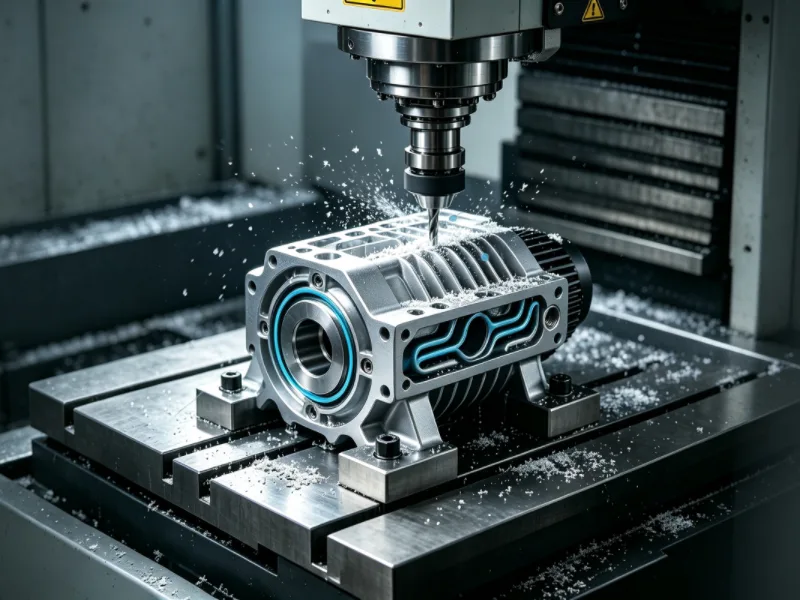
1. Ultra-Thin Wall Structure and Deformation Risk
Most EV lightweight parts adopt thin-wall aluminum structures, with wall thickness ranging from 3mm to 6mm. These designs effectively reduce vehicle weight and extend battery range, but they are extremely sensitive to cutting force, clamping pressure, and machining heat.
Common problems include:
- Part warping after roughing
- Shrinkage or expansion after finishing
- Out-of-round motor housing bores
- Unstable flatness on large battery cover panels
Solutions:
- Adopt a standard process: roughing → stress relief → secondary finishing
- Release clamping pressure periodically to eliminate internal stress
- Use vacuum fixtures and low-torque positioning to avoid forced deformation
- Apply high-speed low-feed milling to reduce cutting resistance
2. Strict Tolerance Requirements for Powertrain Parts
EV motor housings, shaft sleeves, and inverter installation surfaces require far tighter tolerances than traditional auto parts.
Typical industrial standards:
- Bore roundness ≤ 0.01mm
- Concentricity ≤ 0.02mm
- Mounting surface flatness ≤ 0.03mm
Even minor deviations will cause motor vibration, abnormal NVH noise, or assembly failure.
Solutions:
- Use 4-axis and 5-axis simultaneous machining to reduce secondary clamping errors
- Complete multi-surface processing in one setup
- Perform CMM full inspection for key dimensions
- Reserve reasonable tolerance compensation before anodizing
3. Thermal Expansion and Post-Surface Treatment Shrinkage
Nearly all EV aluminum parts require anodizing, sandblasting, or conductive surface treatment. These processes cause subtle dimensional changes.
Many suppliers fail to reserve coating tolerance, resulting in:
- Thread tightening after oxidation
- Assembly holes becoming too tight
- Sealing grooves mismatched
Solutions:
- Pre-reserve 0.01–0.03mm oxidation tolerance on mating surfaces
- Mask key precision holes before surface treatment
- Perform secondary fine trimming on critical assembly positions
4. Complex Internal Cavities and Cooling Channel Machining
EV water-cooled motor shells and new energy heat sink parts contain irregular internal ribs, deep cavities, and curved cooling channels.
These structures bring challenges:
- Tool vibration during deep cavity processing
- Uneven tool wear
- Difficult chip removal
Solutions:
- Use segmented layered milling
- Apply special alloy cutting tools for aluminum
- Optimize tool path to avoid sudden angle changes
- Adopt dry milling or micro-lubrication for cleaner surface quality
5. High Consistency Requirements for Mass Production
New energy vehicle projects demand extremely high batch consistency. Even tiny differences in flatness, depth, and hole position will lead to assembly batch errors.
Solutions:
- Standardize fixture positioning for all batches
- Unify tool models and cutting parameters
- Record and stabilize processing database
- Implement first article inspection (FAI) + full sampling inspection
Conclusion
CNC machining for EV new energy components is no longer simple mechanical cutting. It requires systematic control of material stress, thermal deformation, tolerance matching, surface treatment compatibility, and batch stability.
Professional EV part manufacturers must balance lightweight design, precision tolerance, and mass production stability.
If you have custom EV motor housings, cooling parts, sensor brackets, or new energy structural components, send us your STEP files. We provide professional DFM analysis, high-precision CNC machining, and stable batch production solutions.